
REVIEW · ANURADHAPURA TOURS
Half day tour – in Sacred city of Anuradhapura Or sacred city of Mihintale.
Morning ruins can be oddly calming. This half-day Anuradhapura route is interesting because it turns famous monuments into a clear story of Buddhism and Sri Lanka’s past, with licensed explanations from Lampa. I love the way the stops are sequenced for learning, not just checkboxes, and the practical touches like snacks and water included. One thing to plan for: admission tickets for the sites are not included, so you’ll want a little extra cash ready.
The tour covers major stupas, monastery ruins, and even small but meaningful details like carved stone stair features and old bathing tanks. You’ll get a strong sense of the city’s scale in a short window, yet the timing is still tight, so if you want to linger a lot at each location, you may feel rushed.
In This Review
- Key highlights to look for
- How a half-day temple loop makes Anuradhapura make sense
- Lampa’s explanations: clear English, practical stories, real context
- Jaya Sri Maha Bodhi in Mahamewna Gardens: start where the story begins
- Lovamahapaya Brazen Palace and the “in-between” feeling
- Ruwanwelisaya: relics, scale, and why stupas pull focus
- Jetavanarama and Abhayagiri ruins: when size becomes the lesson
- Thuparama Dagoba: the first temple story after Mahinda Thero
- Samadhi Statue and the meditation posture you can actually recognize
- Isurumuniya and Kuttam Pokuna: art, stone, and everyday life
- Vessagiriya and the moonstone: the small things that make ruins readable
- Price and logistics: $30 is good value if you come prepared
- Who this tour fits best (and who might want something else)
- Should you book this half-day Anuradhapura or Mihintale tour?
- FAQ
- How long is the half-day Anuradhapura tour?
- What does the tour cost?
- Is pickup included?
- Are admission tickets included for the monuments?
- What is included in the tour?
- Is this a private tour?
- What is the cancellation and weather policy?
Key highlights to look for
- A licensed guide who connects Buddhism and monuments: explanations focus on what each site meant, not just where it is.
- Start at the living sacred Bo tree, Jaya Sri Maha Bodhi: a powerful first stop in Mahamewna Gardens.
- Big stupas plus lesser-known ruins: you see the famous giants and the supporting cast.
- You’ll notice architectural details: like the moonstone (Sandakada pahana) and palace-style remains.
- Snacks, water, and pickup help the day feel easy: less logistics stress, more looking around.
- Admission tickets are on you: the tour price covers the guide and basic extras, not site entry fees.
Deeper into Anuradhapura
- Explore & Ride the history of anuradhapura with Vogel Tours
★ 5.0 · 62 reviews - Delve Into Ancient Anuradhapura with Optional Visit to Mihintale
★ 5.0 · 42 reviews - Anuradhapura Private Ancient City Day Tour
★ 5.0 · 39 reviews - Anuradhapura Heritage Mountain bike / bicycle Tour
★ 5.0 · 34 reviews
How a half-day temple loop makes Anuradhapura make sense
Anuradhapura can feel like a wall of monuments when you first arrive. This kind of half-day tour works because it gives your brain a route, then hands you the meaning behind each stop. You don’t just stand in front of a stupa, you learn what to watch for as you look.
The timing is built around a realistic visit window of about 3 to 4 hours, so you can still keep your day flexible. You get enough stops to feel you saw the core sites, but not so many that you’re exhausted before lunch. You’ll also get picked up, which helps in a city where hopping between points can take longer than it should.
The main tradeoff is simple. When you compress a sacred city into a half-day, you have to choose your pace. This tour moves, even if your guide encourages you to look carefully. If you want long quiet time at every monument, you might prefer a full-day plan.
Lampa’s explanations: clear English, practical stories, real context
This tour is led by Travel With Lampa, and the name matters. In the experiences I’ve read about, Lampa’s English stands out, and the explanations are friendly and story-driven. That makes a difference in Anuradhapura, where many sites look similar at first glance: large ruins, scattered structures, and big religious forms that take a minute to decode.
I like that your guide is a licensed tour guide in Sri Lanka and focuses on monuments, history, and Buddhism. That means the talk tends to answer the questions you actually have while walking: What am I looking at? Who built this? What does this form represent? It’s the difference between memorizing facts and understanding what the buildings were for.
You also benefit from having a guide who can help you move logically between locations. Some monuments are connected by proximity, others by religious development and royal patronage. A good guide keeps you from getting lost in the details and helps you notice the details that really matter.
Jaya Sri Maha Bodhi in Mahamewna Gardens: start where the story begins
You begin at Jaya Sri Maha Bodhi, in the Mahamewna Gardens. This sacred Bo tree matters because it’s treated as a living connection to Gautama Buddha’s tradition. The tour includes about 30 minutes here, which is a good amount of time for your mind to settle.
Look closely at how people treat the tree. Even if you’re not sure about every ritual, you’ll feel the significance immediately. This is the kind of site where your guide’s explanation helps you slow down and understand that you’re not just looking at a big tree, you’re standing at a living symbol.
There is one practical note. The site admission ticket is not included, so you’ll want to handle entry fees on the spot. If you have a hat, water bottle, and sunscreen, this is a smart early moment to use them, since the morning can still get bright and warm.
Other city outings in Anuradhapura

Lovamahapaya Brazen Palace and the “in-between” feeling
Next comes Lovamahapaya, known as the Brazen Palace or Lohaprasadaya. The name hints at why this place is remembered. This structure sits between the areas of Ruwanweliseya and Sri Mahabodiya, which makes it feel like a hinge in the ancient city.
Your stop here is short, about 15 minutes, so this is not the location for a long, slow wander. Instead, it’s a quick context builder. Your guide uses this site to explain how royal and religious architecture worked together in Anuradhapura, and how these monumental spaces functioned as more than just single buildings.
The downside of a short stop is also obvious. If you love ruins and could spend hours spotting every layer, you might feel the time slipping away. The trade is that you get back on track for the big religious landmarks that come next.
As with other stops, admission tickets are not included, so plan for small entry costs throughout the day.
Ruwanwelisaya: relics, scale, and why stupas pull focus
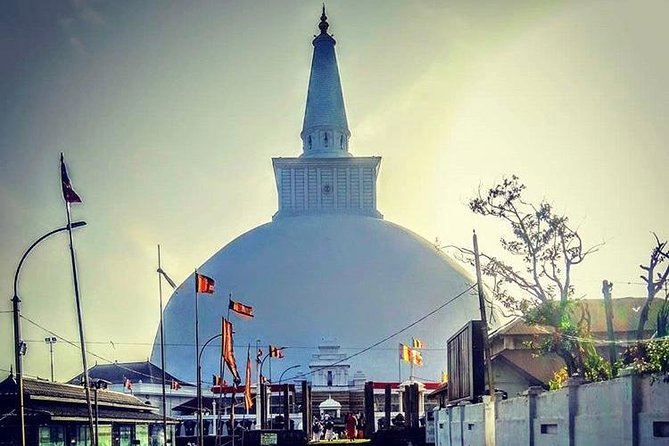
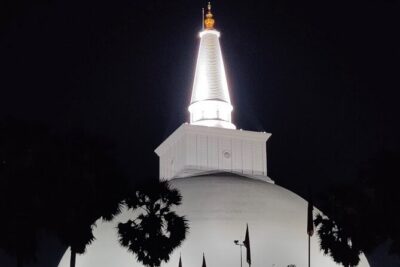
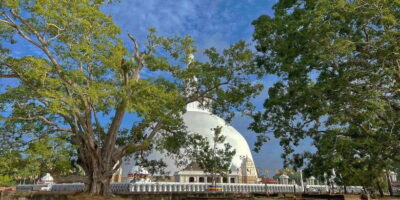
Then you reach Ruwanwelisaya (Ruwanweli Maha Seya), one of the great “have to see it” stupas. You’ll spend about 20 minutes here, and it’s the kind of monument where even from a distance, your body wants to slow down.
A useful thing to know is what a stupa represents in Buddhism. At Ruwanwelisaya, the tour frames the structure as a reliquary, a hemispherical form containing relics. That helps you read the stupa as a physical container of meaning, not only an impressive shape.
Ruwanwelisaya is also a great place for your guide to point out how Anuradhapura’s religious sites relate to each other. When you see this stupa after Lovamahapaya, you can feel the city’s plan: sacred centers, lines of movement, and shared symbolism.
Admission tickets are not included here either, so expect that to be a recurring theme. This is one of those tours where paying small fees at multiple stops is normal, even if it adds up.
Jetavanarama and Abhayagiri ruins: when size becomes the lesson
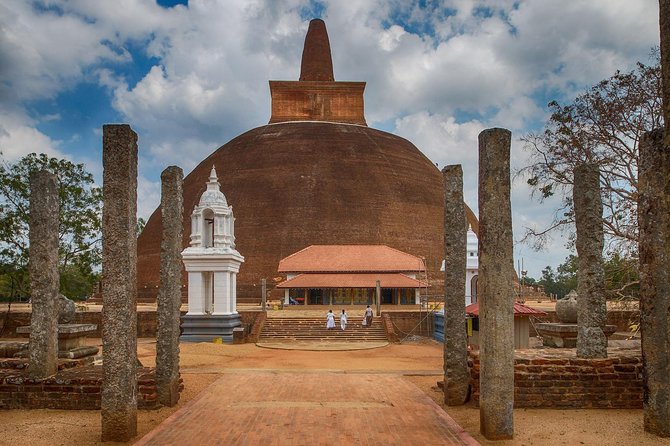
After that, the route moves into heavier ruin territory. You visit Abayagiriya Stupa, connected in the description to Jetavanarama, also called Jetavanaramaya, and located in the ruins of Jetavana monastery. Your time here is about 30 minutes.
Then you go to Abhayagiri Dagaba, the major monastery site linked with multiple Buddhist traditions, described as Mahayana, Theravada, and Vajrayana. This stop is around 20 minutes.
These two locations are where you really understand what “scale” means in Anuradhapura. Standing near large ruins, it’s easy to guess what happened, but harder to get the religious and historical timeline right. Your guide helps you link the monastery remains to the broader development of Buddhism in Sri Lanka.
Also, Abhayagiri is described as one of the most extensive ruins in the world. Even if you don’t remember that sentence later, you’ll feel it in the space. The walking pace matters here. If you’re wearing uncomfortable shoes, these stops can quickly turn into a pain contest.
Another practical note: some stops are tied to areas that can involve additional site entry fees. Since admission is not included, keep your schedule flexible so the money and time don’t become stress.
Thuparama Dagoba: the first temple story after Mahinda Thero
Next is Dagoba of Thuparama (Thuparamaya), described as the first Buddhist temple constructed after the arrival of Mahinda thero in Sri Lanka, connected to Mahindagamanaya. Your visit time is about 20 minutes.
This stop is valuable because it gives you the historical anchor. Rather than treating monuments as stand-alone objects, your guide explains their role in early Buddhism’s spread and establishment. When you understand that a site is tied to the earliest temple story, it changes how you look at it.
Thuparama also pairs well with the surrounding sacred area mention, and your guide’s comments help you see the site as part of a larger landscape of worship and learning. If you’re the type who likes to know why a city became important in the first place, this stop delivers.
Again, admission tickets are not included, so budget for entry fees. The stop is short, so being prepared helps you keep the flow.
Samadhi Statue and the meditation posture you can actually recognize
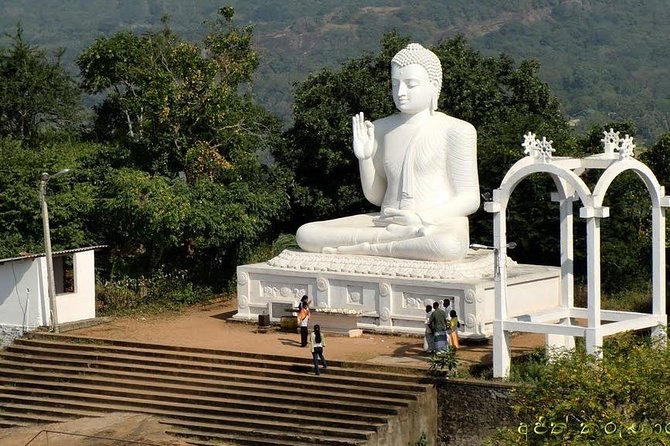
You then visit the Samadhi Statue in Mahamevnāwa Park. The statue shows the Buddha in Dhyana Mudra, the meditation posture tied to his first time associated with enlightenment. The stop is about 15 minutes.
This is a great “mental reset” stop in the middle of the day. After larger religious structures and monastery ruins, a statue focused on meditation helps you shift from architecture to practice. You start thinking about what Buddhism was aiming to train in people: calm, attention, and disciplined mind.
Because it’s a statue, you can also take your time with the visual details, even if your official stop time is brief. If you’ve ever felt that photos of statues fail to show meaning, this is where your guide’s explanation helps your eyes do better work.
No admission ticket is included, so treat this like a site where your small entry fee might be separate.
Isurumuniya and Kuttam Pokuna: art, stone, and everyday life
Then the tour turns to two places that feel more human.
First is Isurumuniya Temple (also described as Meghagiri Vihara or Meygiri Vihara), built by King Devanampiya Tissa. Your stop is about 30 minutes. The guide’s historical framing makes the temple feel less like a ruin and more like a remembered part of a real reign.
Second comes Twin Baths (Kuttam Pokuna), described as old bathing tanks or ponds used in the ancient Anuradhapura Kingdom. Your time is around 15 minutes.
Kuttam Pokuna is the kind of stop that surprises people in a good way. It’s not dramatic like a stupa, but it tells you something important: this civilization cared about daily ritual and hygiene. These ponds are built, used, and preserved in a way that connects religion to routine.
Look closely at the structure and imagine how water management worked. Even on a short visit, your guide can help you see how the city’s sacred life extended into practical systems.
Admission tickets are not included, so expect that pattern to continue.
Vessagiriya and the moonstone: the small things that make ruins readable
Next is Wessagiriya (Vessagiriya), also described as a Buddhist forest monastery. It’s located about half a mile south of Isurumuniya in the ruins of Anuradhapura. Your time is about 20 minutes.
Then comes the architectural detail that many people miss until someone points it out: the Moonstone or Sandakada pahana. This carved semi-circular stone slab is typically placed at the bottom of stupa or stair entrances, and it’s described as part of Sinhalese architectural design.
These are the best stops for slow looking. Vessagiriya gives you a sense of monastic seclusion and the idea of a forest monastery. Sandakada pahana gives you a specific feature to hunt for and appreciate. When you understand what the moonstone is, you start seeing it as a welcome mat for sacred entry, an intentional part of how worship begins.
Because both are included as stops with limited time, you should use your attention rather than trying to see everything. Wear shoes that handle uneven ground, and keep your camera ready but controlled, since you’ll likely want to listen more than you think.
Admission tickets are again not included, so plan for entry fees where required.
Price and logistics: $30 is good value if you come prepared
The price is $30 per person for a half-day tour of about 3 to 4 hours. For that money, you’re getting a private experience led by a licensed guide, plus pickup offered, snacks and water, and a mobile ticket.
Is it worth it? For me, the value comes from the guide quality and the structure of the route. Anuradhapura’s monuments can turn into a blur if you’re walking without context. Paying for guided explanations helps you get meaning out of every stop, and it saves you time figuring out what to see first.
Two things to keep in mind:
- All fees and taxes are not included. That lines up with the repeated note that site admissions are not included for the stops. You should expect to pay some entry costs as you go.
- Air-conditioned vehicle is not included. If you’re sensitive to heat, confirm vehicle comfort with the provider after booking, so you’re not caught off guard.
You’ll start at 8:30 am at Jaya Sri Maha Bodhi (listed with the code 89VW+VV5). The activity ends back at the meeting point. This is helpful because you don’t have to navigate transport afterward.
Who this tour fits best (and who might want something else)
This is a great match if you want a focused introduction to Anuradhapura’s Buddhist sites with clear storytelling, and you like having someone explain what you’re looking at. It’s also ideal if you’re short on time but still want a meaningful, not random, sweep of monuments.
It may not be the best choice if you want long stays at fewer locations, or if you prefer a slower, self-guided visit where you can linger without keeping to a 3 to 4 hour schedule.
If you’re traveling in a small group, the private tour format helps you ask questions without waiting your turn.
Also, since the route includes uneven terrain at ruins, good walking shoes matter.
Should you book this half-day Anuradhapura or Mihintale tour?
If your goal is to understand Anuradhapura in a few hours, I think it’s an easy yes. The route hits major sacred landmarks, monastery remains, and meaningful details like the moonstone. With Lampa leading the explanations in clear English, you’re less likely to leave with only photos and more likely to leave with real understanding.
Book it if you’re ready for a structured half-day, you’re okay paying small admission fees at sites, and you can handle some walking on ancient ground.
If you’re the type who wants a lot of quiet time at each spot, consider a longer day tour instead. But for many first-timers, this is a strong way to get your bearings and start connecting the sacred dots.
FAQ
How long is the half-day Anuradhapura tour?
It runs for about 3 to 4 hours (approx.). The exact pace depends on time at each monument, but it is designed to fit a half-day schedule.
What does the tour cost?
The price is $30.00 per person.
Is pickup included?
Yes. Pickup is offered, and the tour starts at Jaya Sri Maha Bodhi and ends back at the meeting point.
Are admission tickets included for the monuments?
No. The listed admission tickets for the stops are not included, so you should expect to pay site fees separately where required.
What is included in the tour?
Snacks and water are included. You also get a mobile ticket.
Is this a private tour?
Yes. It is a private tour or activity, so only your group will participate.
What is the cancellation and weather policy?
Cancellation is free, and you can cancel up to 24 hours in advance for a full refund. The experience requires good weather, and if it is canceled due to poor weather, you will be offered a different date or a full refund.
More Tours in Anuradhapura
More Tour Reviews in Anuradhapura
Anuradhapura, Deeper
Still browsing Anuradhapura? Start here
- Rangiri Jeep Safari Sigiriya Lion Rock & Evening Jeep Safari★ 4.0 · 3 reviews
- Half Day – Minneriya National Park Safari Tour From Habarana/Sigiriya★ 3.5 · 3 reviews
- Sunrise or sunset tour pidurangala Rock and Sigiriya Rock★ 5.0 · 4 reviews
- Wilpattu Half Day Safari From Anuradhapura★ 5.0 · 4 reviews
- Minneriya National Park Half Day Elephant Safari★ 5.0 · 4 reviews
Anuradhapura Tours, compared.
 ★ 5.0Private City Day Tour in AnuradhapuraFrom $30383 reviews
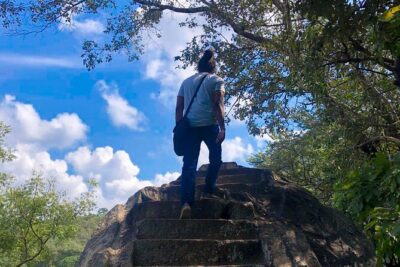 ★ 5.0Explore & Ride the history of anuradhapura with Vogel ToursFrom $4062 reviews
 ★ 4.4From Anuradhapura: All Inclusive Full Day Safari at WilpattuFrom $11750 reviews
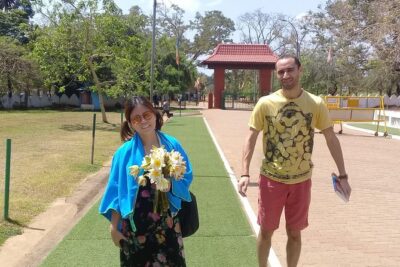 ★ 4.5Day tour sigiriya to anuradhapuraFrom $12045 reviews
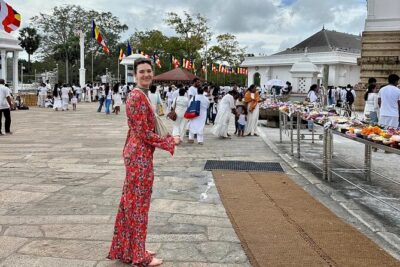 ★ 5.0Delve Into Ancient Anuradhapura with Optional Visit to MihintaleFrom $3042 reviews
 ★ 5.0Anuradhapura Private Ancient City Day TourFrom $3039 reviews
 ★ 5.0Anuradhapura Heritage Mountain bike / bicycle TourFrom $2534 reviews
 ★ 4.5Anuradhapura: Full-Day Wilpattu All Inclusive Private SafariFrom $9024 reviews
Browse the lists this tour appears in